AI Study: YouTube Owns 99% of Video Citations in AI Search, But Only Half the Platforms Care

Director of SEO & Digital Discovery
- Published
- Updated
- Reading time
- 18 min read
Quick answer
When an AI engine cites a video, it cites YouTube: YouTube holds 99% of video citations across the 10 studies reviewed. But the platforms split sharply. YouTube is the most-cited domain in Google AI Mode (21.1% of citations), yet it appears in fewer than 4% of ChatGPT responses, where Reddit leads.
Key takeaways
- YouTube holds 99% of every video citation in AI search.
- Google and OpenAI run structurally different retrieval: YouTube leads Google AI Mode with 21.1% of citations but appears in under 4% of ChatGPT responses.
- YouTube visibility tracks intent and falls off sharply at the bottom of the funnel.
- AI citations have decoupled from Google’s organic top 10: 62.9% of cited URLs don’t rank there.
- The citation pipeline reads transcripts, so a video’s text layer matters more than the footage.
In this article
- The same video, two different verdicts
- Finding 1: YouTube holds 99% of every video citation in AI search
- Finding 2: The great platform divide between Google and OpenAI
- Finding 3: Intent decides everything, and YouTube falls off a cliff at the bottom of the funnel
- Finding 4: AI citations have decoupled from Google’s organic top 10
- Finding 5: The citation pipeline reads transcripts, whatever the model can watch
- Platform-by-platform visibility guide
- What these studies got wrong, and what nobody has answered yet
- What to do about it: A video GEO allocation framework
- Video is a Google AI strategy, not an AI strategy
The same video, two different verdicts
In Google AI Mode, YouTube is the single most-cited domain on the platform, accounting for 21.1% of all citations (Studies 1, 3, 4, 9). In ChatGPT, YouTube appears in less than 4% of responses. The top source there is Reddit (Studies 1, 8, 9). Same videos. Same transcripts. Same content. The only variable is which engine the user opened, and the outcome swings by a factor of five.
That gap is the finding worth building a strategy around, and almost nobody is budgeting for it. We reviewed 10 empirical studies published between March and September 2026 to understand why it happens and what it means for any brand currently funding video.
What was reviewed
10 empirical research reports published between March and September 2026, covering 38 industry verticals and 8 AI platforms (ChatGPT, Google AI Mode, Google AI Overviews, Gemini, Perplexity, Copilot, Claude, Grok).
One thing to fix before the numbers start, because it is where most readers of this research go wrong. “Citation” does not mean the same thing across these studies. Some count hyperlinked URLs, others count domain appearances, others use proprietary visibility indexes.
Most importantly, YouTube’s 99% share of video citations and its 18% to 21% share of total citations have different denominators. Conflating them produces a claim that is off by roughly a factor of five.
The evidence quality is also uneven, five of the ten studies come from vendors selling AI visibility software, and the “30 million citations” figure attached to this corpus belongs to a single study. All of that is documented in the methodology section at the end, with a study-by-study table. Findings drawn from the weakest studies are flagged where they appear.
Finding 1: YouTube holds 99% of every video citation in AI search
When an AI engine cites a video, it cites YouTube. That is close to the whole finding.
5WPR benchmarked video citation share across 38 industry sectors and roughly 3,762 prompts, and found YouTube holding 99% of all video-based AI citations. TikTok, Instagram Reels, and Vimeo divide the remaining 1% (Study 6).
This holds across Google, OpenAI, and the independent engines. The disagreement between platforms is about whether to cite video at all. It is not about which video platform to cite. That remained true through the August 2026 source re-weighting covered in Finding 2, where every major social platform lost ChatGPT citation share at once: YouTube fell further than TikTok in that window, which would move YouTube’s share of video citations by only about a point, and only on ChatGPT.
Video GEO is YouTube GEO. There is no diversified video strategy for generative search, because there is no second platform to diversify into.
One caveat on this number. Study 6 sits in the limited-methodology tier, publishing an index percentage without the underlying URL distribution or citation denominators. No other study in the corpus surfaces meaningful non-YouTube video citations, which is consistent with the finding but is not independent confirmation of it, since none of them set out to measure video share by platform. Treat it as a strong directional finding rather than a precisely measured one.
Finding 2: The great platform divide between Google and OpenAI
This is where the corpus earns its value. The two dominant AI ecosystems are not running the same playbook with different branding. They are running structurally different retrieval architectures that produce structurally different citation economies.
Google’s ecosystem treats YouTube as infrastructure
In Google AI Mode, YouTube is the #1 cited domain at 21.1% of all citations, ahead of Facebook at 17.0% (Study 9). The caveat belongs up front: Study 9 is trade reporting on a proprietary monitoring tool and publishes no sample size. The rank it reports is corroborated by Studies 1, 3, and 4. The precise percentage is not independently confirmed anywhere in this corpus.
In Google AI Overviews, YouTube captures 18% of total citations, and the volume is climbing. Meltwater tracked 188,800 YouTube citations in May 2026 and a record 229,300 in July, a 21.5% increase across those two months. The July figure was a 24.3% month-over-month rebound from June, which means June dipped below May before recovering (Studies 3, 4).
In specific verticals the dominance goes further. Searcherries analyzed 350 Google AI Overviews for vitamin and supplement queries and found YouTube cited in 53.1% of them, or 186 of 350 (Study 7). That is a single platform appearing in more than half of all AI Overviews in a consumer health category, outranking GoodRx and Healthline.
The mechanism is ownership. Google does not retrieve YouTube as an external source. It indexes YouTube transcripts, auto-captions, chapter timestamps, and metadata natively, without needing to render a page or parse a media asset (Studies 1 through 4, 10).
That structural advantage is not just an industry inference. Grossman et al. (2026), a peer-reviewed SIGIR study analyzing 11,500 benchmark queries across Google Search, AI Overviews, and Gemini, found that source overlap between traditional and generative search is extremely low, and that generative search shifts visibility away from popular and institutional domains and toward Google-owned properties.
A peer-reviewed study reached the same conclusion the vendor data suggests, using a different method and a public benchmark dataset.
OpenAI’s ecosystem barely sees YouTube at all
ChatGPT cites YouTube in less than 4% of responses. Its top source is Reddit, followed by Wikipedia and major text publishers (Studies 1, 8, 9). Study 9 puts Reddit at 28.9%, a figure that needs a caveat covered below.
The reason is architectural. ChatGPT uses Reciprocal Rank Fusion to fan a prompt into text-heavy sub-queries, then retrieves rendered web pages. A YouTube watch page is a JavaScript-heavy, media-dominant asset that returns very little extractable text to that pipeline. The system is not rejecting video on quality grounds. It largely cannot read it (Studies 1 through 4).
Microsoft Copilot follows a similar shape: low YouTube citation, heavy lean toward Microsoft-indexed text publishers, LinkedIn, and merchant inventory, with Amazon taking 19% of commercial citations (Studies 5, 9).
August 2026: The divide got wider after most of this data was collected
Nine of the ten studies here collected data before mid-August 2026. In that window, ChatGPT re-weighted its citation sources sharply enough that some of the numbers above are already historical.
Promptwatch tracked reddit.com holding a steady 3.83% of ChatGPT Search citations from July 18 through August 7, then falling to 0.52% between August 14 and 17. An 86.4% relative decline. Two dated events line up with it: on August 8, ChatGPT’s use of the site: operator in its fanout queries jumped from roughly 0.4% to nearly 17%, and on August 14 the share fell off a cliff.
Reddit was not the target. Petra Labs measured the same pattern across the entire user-generated web in the same window, and the YouTube number is the one that matters here:
| Platform | ChatGPT citation decline, mid-August 2026 |
|---|---|
| YouTube | down 88% |
| down 81% | |
| TikTok | down 72% |
| down 36% | |
| down 28% |
ChatGPT shifted toward official company sites, documentation, help centers, and structured review platforms.
A sourcing note on that table. The Reddit collapse is corroborated across Promptwatch’s own published data, Axios, Search Engine Journal, and The Drum. The per-platform breakdown including the YouTube figure traces to Petra Labs, and I reached it through secondary reporting rather than a primary Petra Labs publication.
The Drum independently cites Petra Labs observing declines across YouTube and other social platforms in the same window, which supports the direction. Treat the specific 88% as one firm’s measurement reported at second hand.
Now compare Google over the identical window. Reddit’s share of AI Overview citations moved from about 2.37% to 2.10%, an 11.3% decline with no break point. In AI Mode it went from 2.22% to 1.54%, a 30.5% decline. Both gradual. Neither is a cliff.
Two cautions. This has happened before and partially reversed: Reddit fell from 14% to under 1% in September 2025 and recovered to roughly 2%, then fell from about 7% to under 1% in June 2026 and recovered to around 5% over the following two months.
Treat the August numbers as a current state, not a permanent one. Promptwatch is itself a GEO analytics vendor, which places it in the same category this article flags elsewhere, though the pattern was independently reproduced by Petra Labs and reported by Axios, Search Engine Journal, and The Drum.
One more thing this exposes. Study 9 reports Reddit as ChatGPT’s top source at 28.9%. Promptwatch, tracking reddit.com’s share of all ChatGPT Search citations in the same period, measured 3.83% and called it one of the largest shares of any single domain. Those two numbers cannot both be share-of-all-citations. Study 9‘s figure is almost certainly measuring something else, most likely the share of responses mentioning Reddit rather than the share of citations going to it. Read the 28.9% as a rank signal rather than a citation share.
Finding 3: Intent decides everything, and YouTube falls off a cliff at the bottom of the funnel
YouTube visibility is not a fixed property. It tracks user intent, and the swing is severe.
Top of funnel. For informational, educational, and how-to prompts, YouTube citation rates reach 53.1% in consumer health and supplement queries (Study 7) and lead across explainer and category-learning prompts generally (Study 2).
Bottom of funnel. Ten Speed analyzed 7,387 citations from B2B SaaS vendor evaluation prompts, the “Vendor A vs. Vendor B” queries buyers run when they are close to a decision. YouTube took roughly 4%. Product pages took 24.1%. Articles took 17.4% (Study 8).
| Funnel stage | YouTube citation share | Who wins instead |
|---|---|---|
| Informational / educational (TOFU) | 53.1% | YouTube leads |
| B2B vendor evaluation (BOFU) | ~4% | Product pages (24.1%), articles (17.4%) |
That is a thirteenfold drop across the funnel on the same platform.
One gap in Ten Speed’s breakdown is worth naming, because it changes what you do with the finding. The published categories are product pages, articles, Reddit, and YouTube. There is no review-aggregator category. In my own study of 500 citations across five AI engines on B2B software queries, review aggregators (G2, Capterra, Software Advice) took 42% of all citations and 68% of commercial-investigation citations specifically, holding the first-cited position 54% of the time.
Either Ten Speed’s “articles” bucket is absorbing aggregator pages, or the category is missing from the breakdown. Both readings point the same direction: at the bottom of the funnel, the citation is going to a third party who reviews your product, not to a video you made about it.
The implication is specific. YouTube is a discovery channel in AI search, not a conversion channel. If you are funding video to win commercial comparison queries, the data says you are funding the wrong asset. Product documentation, structured product pages, and presence on the review platforms win that ground.
Finding 4: AI citations have decoupled from Google’s organic top 10
This finding contradicts the assumption most SEO programs are still built on. Ahrefs analyzed 1.9 million AI Overview citations on unpersonalized SERPs and found that 62.9% of cited URLs do not rank in Google’s organic top 10 for the same query. Only 37.1% overlap (Study 10).
Of the non-ranking citations, 18% come directly from YouTube, pulled through SERP video carousels, transcript indexing, and semantic alignment rather than through blue-link rankings (Study 10).
There is a temporal story inside this number. Earlier benchmarks put top-10 overlap as high as 76%. The drop to 37.1% reflects the expansion of query fan-out processing, which lets AI Overviews pull from SERP features, entity databases, and transcript repositories that never held a top-10 position (Study 10).
What this implies in practice, and it is an inference from the decoupling rather than a directly measured result: a YouTube video with 500 views and a precise transcript answer to a sub-query can be cited ahead of a million-view video with no usable transcript. Ranking is not the gate. Retrievability is.
Finding 5: The citation pipeline reads transcripts, whatever the model can watch
This is the most immediately usable finding in the corpus, and it needs one correction that most coverage of this topic gets wrong.
Gemini can watch video. Google documents video understanding in the Gemini API, and you can paste a public YouTube link into Gemini and get back a summary, extracted steps, or answers about specific moments, with the model processing audio and visual components. Workspace users can do the same with video files in Drive. Anyone claiming AI categorically cannot process video is describing 2024.
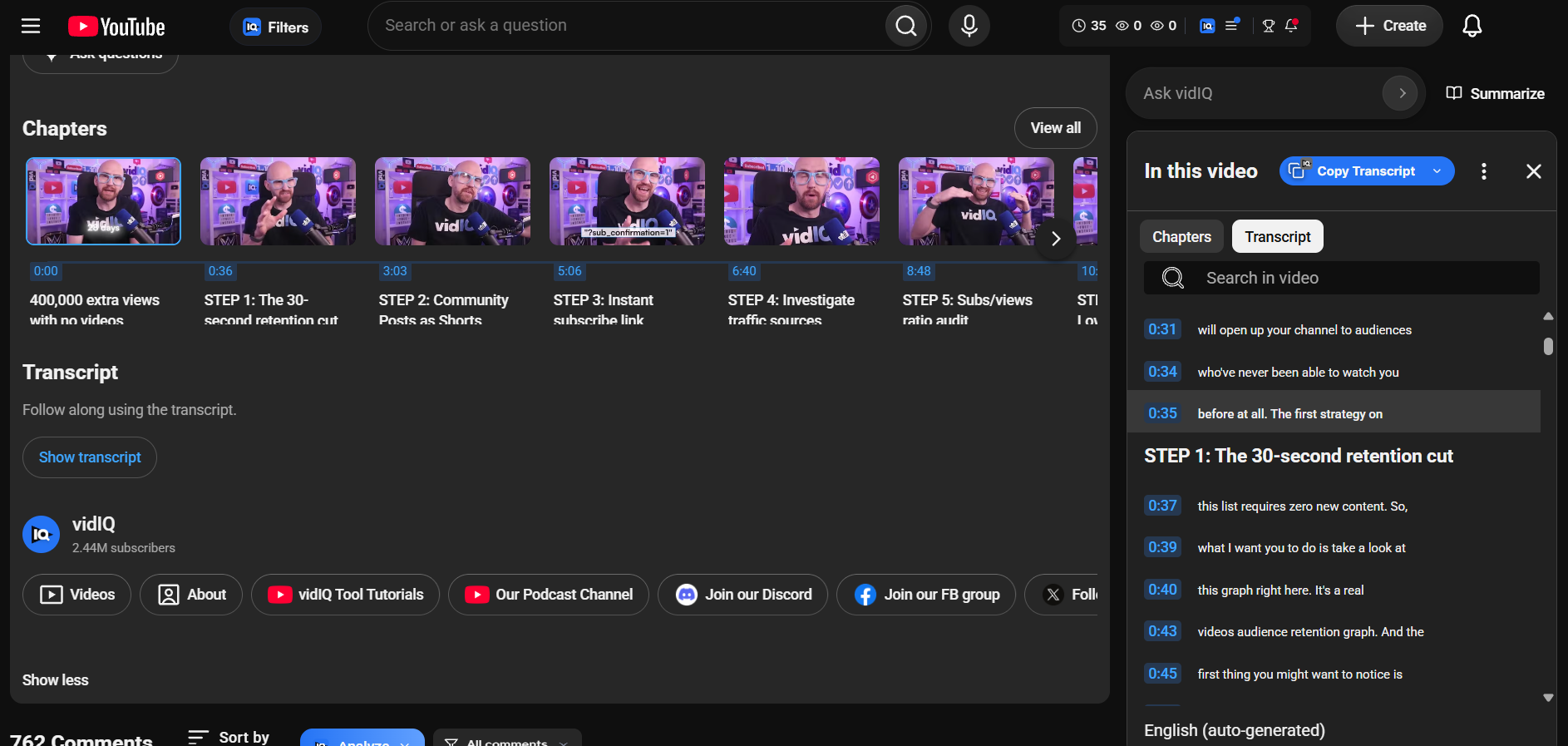
The distinction that matters is between what a model can do when you hand it a video and what the citation pipeline does when it selects sources for an answer. Those are different systems. Nothing in this corpus shows visual frame analysis participating in citation selection, and every observable signal points at text. Ahrefs found the median description length on cited videos sits at 407 words (Study 10). That is not a video description in the conventional sense. That is a page.
So the working model is this: generative engines select and cite based on the text artifacts attached to a video, meaning transcripts, descriptions, timestamped chapters, and closed captions (Studies 1 through 4, 10). An uncaptioned video, or one carrying inaccurate auto-transcripts, is functionally invisible to citation selection regardless of production value or engagement. Call it the transcript threshold: below it, nothing else you do to the video matters.
Whether Google’s AI Overviews use Gemini’s multimodal capability during retrieval is an open question nobody has tested, and it is the one I would most like answered. It sits in the unanswered questions section below for a reason.
Zhang et al. (2026) gives the mechanism from the retrieval side. Analyzing 21,143 valid search-layer citations across 602 controlled prompts on ChatGPT, Google AI Overviews and Gemini, and Perplexity, they separated citation selection from citation absorption, meaning how much a cited page actually shapes the generated answer.
Their finding is that pages achieve absorption through semantic alignment, structural legibility, and evidence density. Applied to video, that is a description of a good transcript.
| Structural profile of an AI-cited YouTube asset | Observed value |
|---|---|
| Median description length | 407 words (Study 10) |
| Transcript coverage | 100%, auto-generated or manual |
| Chapter structure | Timestamped key moments present |
| Primary ingestion source | Text transcripts and closed captions |
| SERP source tier | 18% pulled from non-top-10 features |
And here is the negative finding, stated carefully because the distinction matters. Not one of the ten studies reports a relationship between subscriber count, view count, or virality and AI citation probability (Studies 1 through 10). That is not the same as ten studies testing for it and finding nothing.
None of them appears to have tested it directly, so the honest reading is an absence of evidence rather than evidence of absence. It is still the best available answer, and it points the same way as the decoupling finding above, but it is a weaker claim than it is usually presented as.
Platform-by-platform visibility guide
| Platform | YouTube share | Rank | Primary competitors | Strategic read |
|---|---|---|---|---|
| Google AI Mode | 21.1% | #1 | Facebook (17%), LinkedIn, Reddit | The highest-return surface for video. Optimize transcripts specifically for this. |
| Google AI Overviews | 18%–53.1% | #1 | Reddit, Healthline, GoodRx, Wikipedia | Swings hard by vertical. Consumer health is dominant, B2B is marginal. |
| Gemini | 14.5%–16% | #2 | Reddit, Wikipedia, Medium, PCMag | Shares Google’s transcript infrastructure. Core source. |
| Perplexity | 10%–12.5% | #2–4 | Reddit, LinkedIn, Wikipedia, G2 | Moderate. Parses watch pages and descriptions in real time. |
| Copilot | Low | Bottom tier | Amazon (19%), LinkedIn, text publishers | Commerce and text-heavy. Video is not a priority source. |
| ChatGPT | <4%, and down a further 88% since mid-Aug 2026 | Bottom tier | Official sites, docs, help centers, structured review platforms | Effectively absent. Text-dominant, and the August re-weighting pushed it lower. |
These figures combine Studies 1, 3, 4, 5, 8, and 9, whose methodologies differ, plus Promptwatch and Petra Labs tracking for the August 2026 movement. Treat them as directional benchmarks rather than precise measurements. The ChatGPT row in particular is a moving target.
What these studies got wrong, and what nobody has answered yet
A meta-analysis that does not audit its own sources is just an aggregation.
Where the corpus is weakest
The “30 million citations” figure is not what it looks like. You will see this corpus described that way. Here is the actual accounting.
| Study | Source | Citations disclosed | Tier |
|---|---|---|---|
| 1 | Peec AI | 30,000,000 sources | Moderate |
| 2 | Peec AI | Not reported (500,000 prompts) | Moderate |
| 3 | Meltwater | 8,000,000+ | Strong |
| 4 | Meltwater | Not reported | Strong |
| 5 | Tinuiti | Not reported | Limited |
| 6 | 5WPR | Not reported | Limited |
| 7 | Searcherries | 350 AI Overviews | Moderate |
| 8 | Ten Speed / SEJ | 7,387 | Moderate |
| 9 | Digiday / Sitecore | Not reported | Limited |
| 10 | Ahrefs | 1,900,000 | Strong |
Five of the ten never publish a citation count. Of the roughly 39.9 million that are disclosed, 30 million belong to Study 1 alone, which is 75% of the total. And Study 1 reports ranks rather than percentages, so the specific figures this article leads with come from elsewhere.
Ahrefs and Meltwater anchor the strong tier. Tinuiti, 5WPR, and Digiday publish directional percentages without denominators, query lists, or confidence intervals, and two of this article’s most quotable numbers come from that tier.
- Vendor incentive: Five of the studies come from companies selling AI visibility tracking: Peec AI, Meltwater, and Tinuiti through Profound. Volatility in AI search is the reason their product exists. Weight accordingly, and prefer independent evidence where it exists. Note also that Studies 1 and 2 share the Peec pipeline while Studies 3 and 4 share Meltwater’s, so neither pair independently confirms the other.
- A live example of why that matters: Peec AI reports that AI Overviews trigger on 87% of queries (Study 2). Grossman et al. (2026), peer-reviewed and working from a public 11,500-query benchmark, found AI Overviews generated for 51.5% of representative real-user queries. That is a 35-point gap. Some of it is sampling: a vendor’s prompt set is not a representative distribution of real-user queries, and prompt sets built to test AI visibility will over-index on the queries that produce AI answers. But the size of the gap is a warning about taking any single vendor number as the state of the world.
- Platform volatility: These systems update weights, indexes, and system prompts without announcement. March 2026 findings may not describe September 2026 behavior. Every number here is a snapshot.
- Personalization: Nearly all of this data comes from unpersonalized headless browser sessions on fixed IPs. Real users are logged in, located somewhere, on a device, with history. Nobody has measured what that does to video citation rates.
- Correlation is not self-preferencing: Google’s AI surfaces cite YouTube heavily, and Google owns YouTube. That correlation is real and Grossman et al. confirm the directional bias toward Google-owned properties. It still does not isolate intentional preference from architectural advantage. Native transcript access would produce the same result without anyone deciding to favor anything.
- Definition drift: Covered above, and it remains the single easiest way to misread this research.
What nobody has tested
- Does manually uploading a structured, keyword-optimized transcript increase citation probability compared with relying on auto-captions? No controlled A/B test exists anywhere in this corpus.
- Are Google AI Overviews evaluating visual frames through multimodal models, or is every citation derived from text parsing? When on-screen text conflicts with the spoken transcript, nobody knows which one gets extracted.
- Do verified brand channels outrank independent creators for citation when transcript content, video age, and view count are held constant?
That first question is the one worth running. It is cheap, it is testable, and the entire transcript-optimization industry currently rests on an untested assumption.
What to do about it: A video GEO allocation framework
Six moves. Each one traces to a specific finding above.
- Treat YouTube as Google AI infrastructure, not a social channel. Evidence: YouTube is the #1 source in Google AI Mode at 21.1% and in AI Overviews at 18% to 53.1% (Studies 1 through 4, 7, 9). Move the budget line. YouTube investment is a Google AI visibility play, and it should be measured against citation inclusion in AI Mode, AI Overviews, and Gemini rather than against channel growth.
- Stop expecting YouTube to work on ChatGPT. Evidence: ChatGPT cites YouTube in under 4% of responses, and that share fell a further 88% in mid-August 2026 (Studies 1, 8, 9; Petra Labs). For OpenAI ecosystem visibility, fund text. Long-form articles, genuine Reddit participation, publisher placements. Video is not a viable channel there, and no amount of production quality changes that, because the limitation is in the retrieval pipeline rather than in your content.
- Optimize transcripts like landing pages. Evidence: median description on cited videos is 407 words; transcripts are the ingestion layer (Studies 1 through 4, 10). Upload accurate and fully optimized transcripts rather than relying on auto-captions. Add chapter markers that mirror the phrasing your audience actually uses. The transcript is the page that gets cited, so treat it as one.
- Match video topics to funnel stage. Evidence: 53.1% citation share on informational health queries, roughly 4% on B2B vendor evaluation (Studies 2, 7, 8). Build video for “how to,” “what is,” and “best for” queries. For “Vendor A vs. Vendor B,” build product pages and structured data instead. Funding video against bottom-of-funnel comparison queries is funding the wrong asset for the job.
- Don’t worry about views. Evidence: no study in the corpus reports a relationship between views, subscribers, or virality and citation probability, though none tested it directly (Studies 1 through 10). A 500-view video whose transcript answers a specific sub-query precisely gets cited ahead of a million-view video that does not. Optimize for semantic alignment between transcript passages and real queries. Report on citation inclusion, not engagement.
- Track AI citation separately from organic rank. Evidence: 62.9% of AI Overview citations do not rank in the organic top 10; 18% of non-ranking citations are YouTube (Study 10). Ranking in YouTube search or Google web search does not predict AI citation. These are two systems drifting apart, and a dashboard that only measures one of them will report success while the other erodes.
Video is a Google AI strategy, not an AI strategy
The through-line across all ten studies is that video visibility in generative search is not one market. It is two.
On Google’s surfaces, YouTube is the single most important source in the entire citation ecosystem, taking up to one citation in five and more than half of AI Overviews in some consumer categories. On OpenAI’s surfaces, it is close to absent, displaced by Reddit, Wikipedia, and text publishers.
The divide is not about content quality, and no amount of better video closes it. Google reads YouTube transcripts natively. ChatGPT cannot render a watch page well enough to extract from it. The ingestion pipeline picks the citation, and the pipeline was built before your content was.
For anyone allocating budget: video is not a universal AI visibility strategy. It is a Google AI visibility strategy, and within that, a top-of-funnel one. The brands that win this will be the ones that treat transcripts as structured content assets, aim video at informational intent, and stop reporting views as though they predicted anything.
Study reference index
| # | Study | Source | Date |
|---|---|---|---|
| 1 | Top domains cited by AI search (30M sources) | Peec AI | March 31, 2026 |
| 2 | AI Overviews is the most undertracked AI search: 500,000 prompts | Peec AI | May 28, 2026 |
| 3 | AI Search Visibility Report, June 2026 | Meltwater | July 3, 2026 |
| 4 | AI Search Visibility Report, July 2026 | Meltwater | August 14, 2026 |
| 5 | Q2 2026 AI Citation Trends Report | Tinuiti | Q2 2026 |
| 6 | AI Video Citation Index 2026 | 5W Public Relations | May 2026 |
| 7 | YouTube Appears in 53% of Google AI Overviews for Vitamin and Supplement Searches | Searcherries | September 5, 2026 |
| 8 | Product Pages Get 24% Of AI Citations, Reddit & YouTube 4% | Search Engine Journal / Ten Speed | September 3, 2026 |
| 9 | In Graphic Detail: Inside the Scramble to Measure a Brand’s AI Visibility | Digiday / Sitecore Scrunch | September 15, 2026 |
| 10 | Update: 38% of AI Overview Citations Pull From The Top 10 | Ahrefs | March 2, 2026 |
References
Grossman, R., Liu, S., Chen, M. K., Smith, M., Borcea, C., & Chen, Y. (2026). How generative AI disrupts search: An empirical study of Google Search, Gemini, and AI Overviews. In Proceedings of the 49th International ACM SIGIR Conference on Research and Development in Information Retrieval (pp. 448–459). Association for Computing Machinery. https://doi.org/10.1145/3805712.3809667
Zhang, K., He, X., & Yao, J. (2026). From citation selection to citation absorption: A measurement framework for generative engine optimization across AI search platforms [Preprint]. arXiv. https://doi.org/10.48550/arXiv.2604.25707
About the author
Timothy Prestianni
Director of SEO & Digital Discovery · SEO and AI search consultant
Timothy has spent over 15 years leading SEO for agencies, universities, enterprise organizations, SaaS companies, and e-commerce brands. He holds a Master of Science in Marketing and researches how AI answer engines choose what to cite. Everything he publishes comes from active client work.